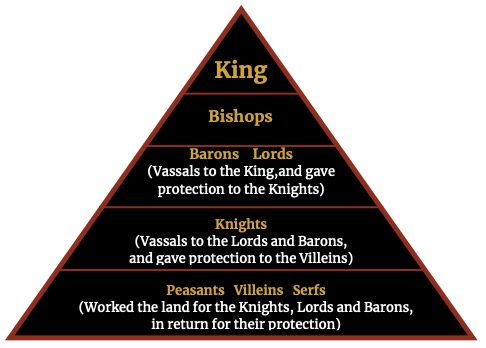
| The feudal system was the main social structure during the Middle Ages. Feudalism meant a hierarchy of social status, with the King at the top and the unfree peasants, or villeins, at the bottom. In between came the bishops and the nobility, knights, merchants, yeomen and other freemen, known as vassals. The system worked like a pyramid, in which you owed service to the rank above you, and could expect to receive service from those below you. Women took their social status from their father before marriage, and then from their husband, although they could own their own land and even their own businesses if they were widowed and there were no male heirs. |
Lord Rory of Hambrig embraces this system, mostly because it’s all he knows. His father always told him that every man has his place in life, but all should be respected. A peasant, he declared, is no less a person than a lord, he just does a different job. But when Rory repeats this piece of wisdom to his new friend Jonny, as they leave France to go on Crusade, Jonny snorts in derision. Neither of the two young men has ever known poverty or serfdom, but Jonny has known hardship and struggle, which Rory has not. The Lord of Hambrig’s wise sayings are never repeated!
In Medieval times, the word “feudalism” was not used. Instead, people spoke of “fiefs” (land granted by a lord to a vassal), “homage” and “fealty” (oaths of loyalty and service), and “tenure” (the conditions by which land was held). These practices were not thought of as part of a single, unified system.
The word “feudalism” emerged in the 18th century as an historical label, usually in a critical or pejorative sense. 18th century scholars denounced medieval society as oppressive and unjust – the very opposite of the Enlightenment, with its new freedoms.
In the 19th century, the pyramid model was devised to explain how society was structured in the Middle Ages. This view was widely accepted, but it’s an oversimplification, and takes no account of differences between countries, or even between the regions of any one country.
In the 20th century, scholars argued that feudalism never existed as a unified system, but was a retrospective invention. Nonetheless, our pyramid is broadly accurate, and it’s fair to say that social mobility in 13th century Europe was rarely achieved. That’s not to say it didn’t happen, but the majority of people lived and died within the same social stratum.
