There is a particular comfort in the idea of a lost land. To call a place “lost” is to suggest accident rather than intent, misfortune rather than resistance. It softens the violence required to take it back. Across centuries, rulers have returned to this language again and again, finding in it a way to make war feel like restoration.
The idea of a “lost land” is the main subject of the first book in Tales of Castle Rory. In The Box of Death the tribe of Celts, banished to the swamps known as “Blurland”, want to reclaim their original homeland on the other side of a wide, fast-flowing river. The treaty has been lost, and the King of Mallrovia denies it ever existed. The Celts resort to aggression and invasion. Although they fail in this, their subsequent attempts at peaceful negotiation are successful. The “lost land” is reclaimed – for a while, anyway.
When Edward I marched into Wales in the late thirteenth century, he did not believe he was conquering a foreign country. Wales, in his mind, was a land that had slipped from proper control, and was now ruled by princes who had forgotten their obligations. Treaties had been broken, homage imperfectly rendered, borders insufficiently respected. What followed, therefore, was not invasion but correction. Order would be restored; law would be imposed; the world would be put back as it ought to be.
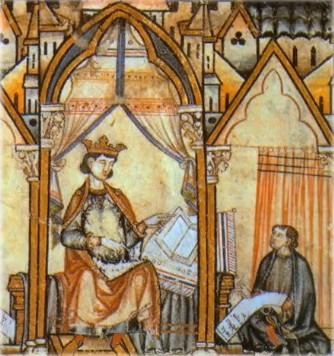
Book 5 of the Tales is called The Paradise Garden. One of the threads running through this book – and it’s laid before the reader right from the start, in the Prologue – is the taking over of all Spain by Alfonso X of Castile. Alfonso X was an inspired leader of men. He was a musician, a scholar, a seeker of knowledge and a man who made friends of Jews, Christians and Muslims alike. But he was also a conqueror. One of the last (although not the last) Iberian lands to hold out against him was Murcia, and it’s in Murcia that Book 5’s Prologue is set.
The Muslims of Murcia were killed, driven out or forced to convert to Christianity. Although it’s true that the Muslims themselves had conquered the area in the early 8th century, defeating the Christian Visigoths who lived there, by Alfonso’s time the Muslim population had been settled in Murcia for centuries. Tellingly, Alfonso called his campaign the Reconquista – the “Reconquest”. He was only taking back what was rightfully his. Restoring the country to Christianity. This is the eternal narrative of those who believe that their right to own and rule the land is more important than the lives of those currently living there. To Alfonso, Murcia was a “lost land”. To the Muslims who’d lived there for generations, it was their home.
King Alfonso X of Castile (“the Wise”), from the Cantigas de Santa María (c. 1250–1280). Contemporary manuscript illumination. Public domain.
Source: Cantigas de Santa María, Codex Rico (13th century), Royal Library of the Monastery of San Lorenzo de El Escorial (Patrimonio Nacional, Spain). Public domain.
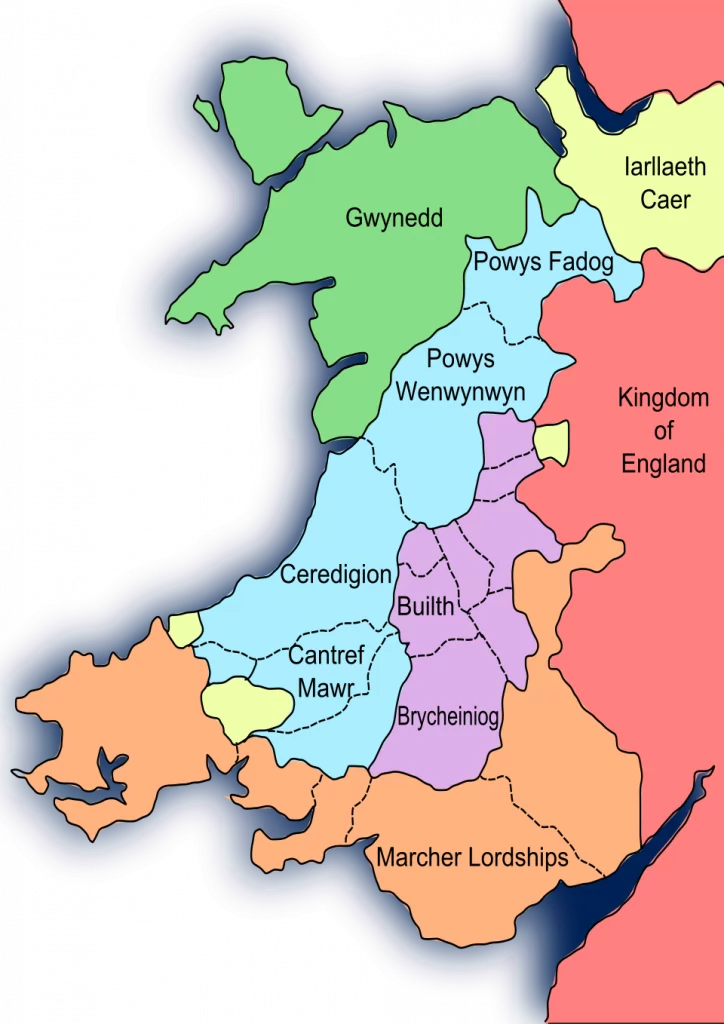
WALES AFTER THE TREATY OF MONTGOMERY, 1267
created by AlexD licensed under CC BY-SA 3.0 via Wikimedia Commons
In Tales of Castle Rory, Book 9 is called The Whisper of Hiraeth. “Hiraeth” is a Welsh word. At its most basic, it means homesickness, but in reality it’s much more than that. “Hiraeth” directly invokes the idea of a “lost land” – lost, that is, to the person feeling the emotion. The Whisper of Hiraeth directly references the conquest of Wales by the English king.
Edward thought he was reclaiming his own lost land. Yet Wales was not lost. Its rulers traced their own lineages. Its laws shaped daily life, its language felt sacred. Edward’s certainty rested on a particular reading of the past, one that remembered only moments of English dominance, and ignored long stretches of Welsh independence. History was distorted, trimmed of its inconvenient parts.
Something similar echoes in the twenty-first century – in Vladimir Putin’s insistence that Ukraine is not truly separate from Russia. Here too the language is not of conquest but of return. Ukraine is framed as a wayward fragment, detached by error and manipulation, its independence a historical misunderstanding. It has to be corrected by force. The past is examined selectively: ancient Rus, imperial borders, Soviet inheritance. Whole centuries of Ukrainian self-definition are pushed aside as though they were footnotes rather than a people’s experience.
In both cases, the people who live on the land are treated as secondary to the story told about it. Their consent is unnecessary if the narrative is strong enough. If a ruler can persuade himself, and enough others, that a territory has always belonged elsewhere, then resistance becomes not self-defence but defiance. Violence becomes regrettable but necessary, a means to end disorder rather than create it.
There is danger in this way of thinking. It assumes that history has a single, correct direction, and that power decides. But to choose one moment and declare it definitive is to silence all the others.
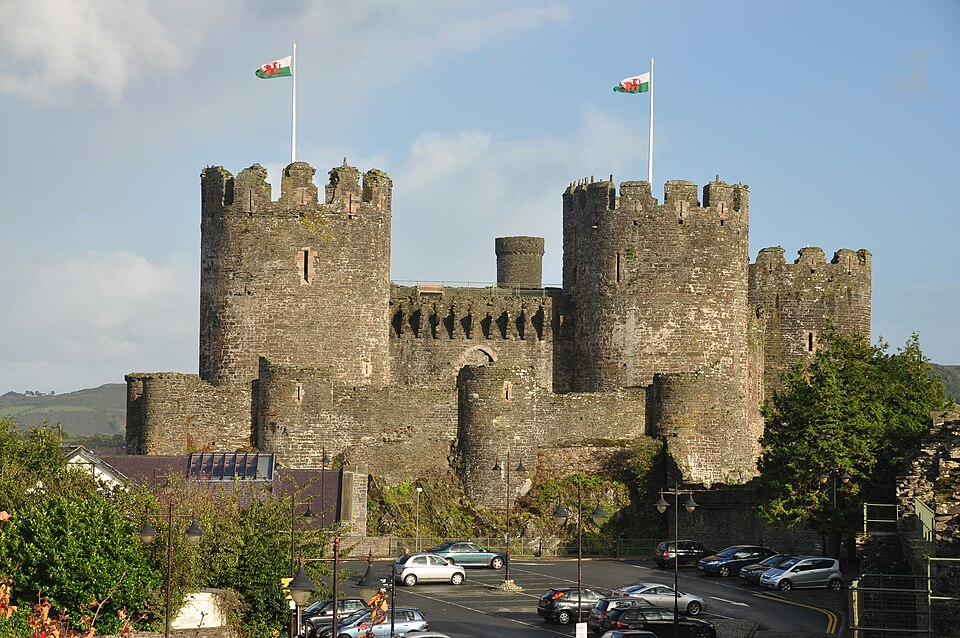
CONWY CASTLE
photograph by Nilfanion licensed under CC BY-SA 4.0 via Wikimedia Commons.
Edward I ultimately succeeded. Wales was absorbed, its castles standing as stone arguments that “resistance is futile”. The story of loss was made real by force. Yet even then, the past refused to be silenced. Welsh identity survived conquest, law, and punishment, carrying its own memory beneath the imposed one.
Ukraine’s story is still unfolding. What is already clear, however, is that attempts to erase or diminish its nationhood have instead sharpened it. The insistence that Ukraine is merely a lost part of something greater has only underlined the cost of such thinking – in lives and in разрушенные города (ruined cities).
Perhaps this is the lesson: the idea of “lost lands” may comfort those who wield power, but it rarely reflects the truth. Countries are not mislaid objects waiting to be retrieved. They are lived in, argued over, and remembered differently by their inhabitants. When the past is used to justify violence, it is usually because the present does not consent.
And so the phrase “lost land” should always give us pause. It tells us less about the past than about the needs of those who invoke it. The Celts got their land back, but at great cost, and only after violence failed and subsequent diplomatic efforts prevailed. Edward I in Wales unleashed bitter hatred and an enduring defiance. The effects of Putin’s invasion of Ukraine are yet to be known, but are likely to be similar. The lessons of history are clearly yet to be learnt.
I write historical fiction set within a carefully researched medieval framework, and I am open about where history ends and invention begins. Each volume in Tales of Castle Rory concludes with an Author’s Note, explaining which elements are historically attested, which are fictional extensions of the record, and which move deliberately into fantasy. The stories are rooted in real medieval experience – with the workings left visible.

