-
Warfare in the Thirteenth Century
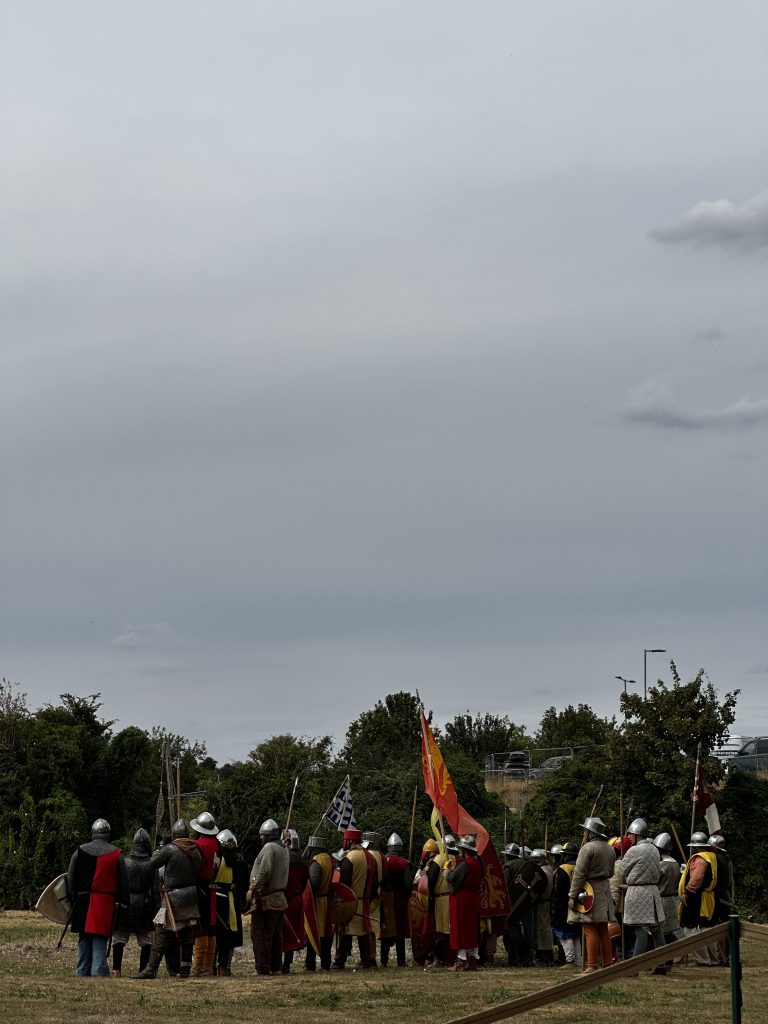
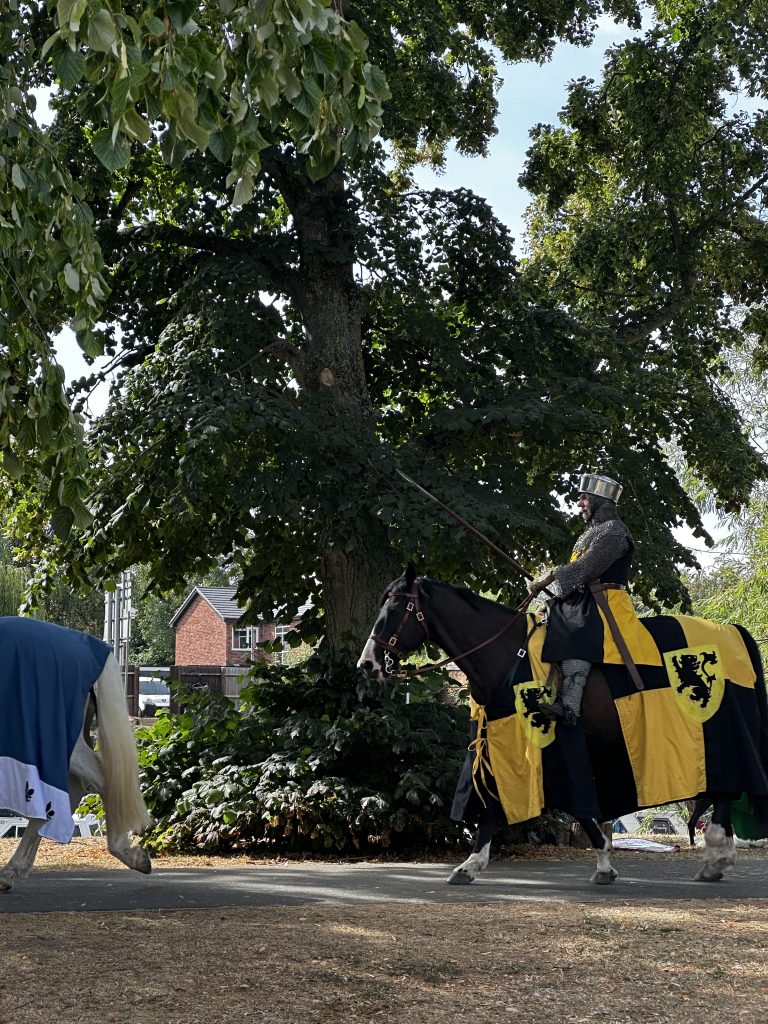
I’ve just returned from a medieval festival in which the Battle of Evesham is recreated in the town where it took place in August 1265.
In 1265, the battle was between the King of England (Henry III) and Simon de Montfort, the Earl of Leicester, backed up by a large number of English barons and their armies.
At Lewes in Sussex, in 1264, the barons won and the king was taken prisoner. At Evesham, fifteen months later, the situation was reversed. De Montfort was killed, the barons were slaughtered and the King of England was reinstated.
Now, last weekend, the re-enactors were good! There were horses. Arrows flew through the air. There was a lot of noise and shouting and the appearance of chaos – genuine battle vibes!
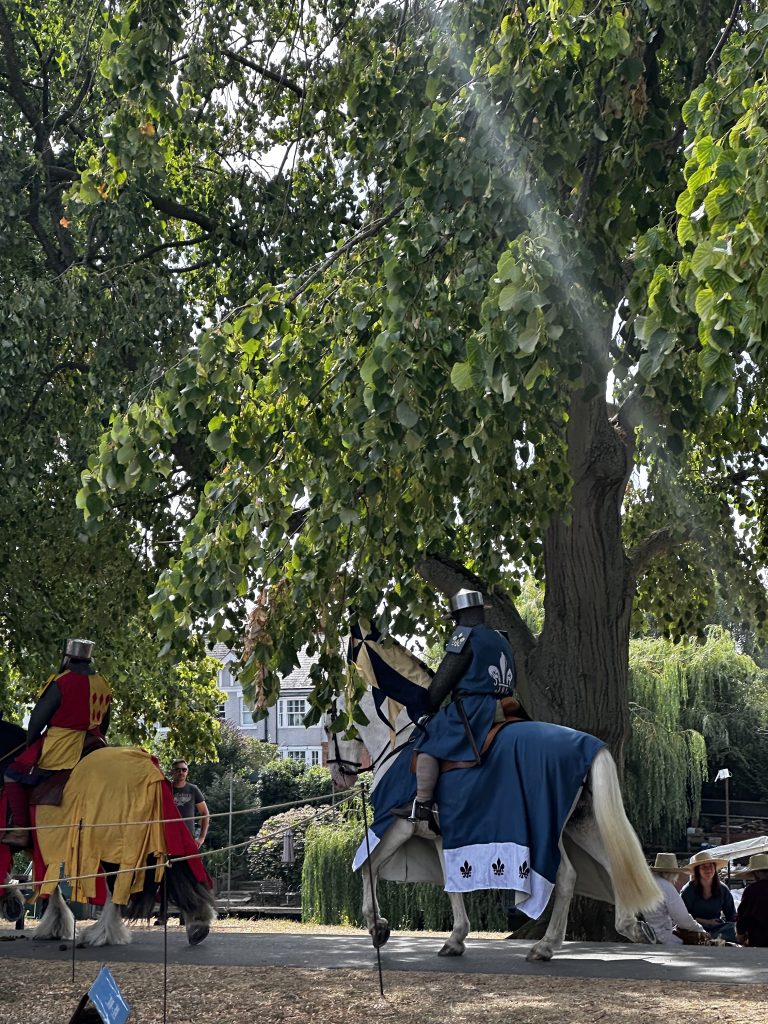
But, of course, it wasn’t real. Nor was it in exactly the right place, and nor did it have the vast armies of thousands. So it was fun for the spectators (and, probably, even more fun for those taking part!) – but what was thirteenth century warfare really like?
Well, it wasn’t simply banners unfurled beneath a clear sky, with knights charging in glittering ranks while trumpets sang. More often, it was mud, confusion, hunger, and fear – and moments of sudden, terrible violence.
Yet within that chaos, there was structure. Warfare followed patterns shaped by land, season, politics, and the limits of human endurance. The battles were only a small part of medieval warfare. In between the battles came the marching, the watching and the waiting.
The Nature of War
In this period, wars were seldom fought for annihilation. Lords sought advantage – land, tribute, loyalty – not wholesale destruction. Campaigns were usually seasonal, beginning in late spring and ending before winter closed the roads and emptied the granaries.
Armies were not standing forces but gatherings of obligation. A lord called his vassals; they arrived with their men, bound by feudal duty. Service was limited – often forty days – after which soldiers expected either payment or release. This alone shaped strategy. A commander could not linger indefinitely. Decisions had to be made within the narrow window that time allowed.
Arms and Armour
A mounted knight in full mail was a formidable presence. His horse, trained for war, was as much a weapon as the sword he carried.
But knights were few. The backbone of any army lay in its infantry: spearmen, billmen, and archers. These men wore little armour – perhaps a padded gambeson, sometimes a simple helmet – and carried weapons that were practical rather than noble.
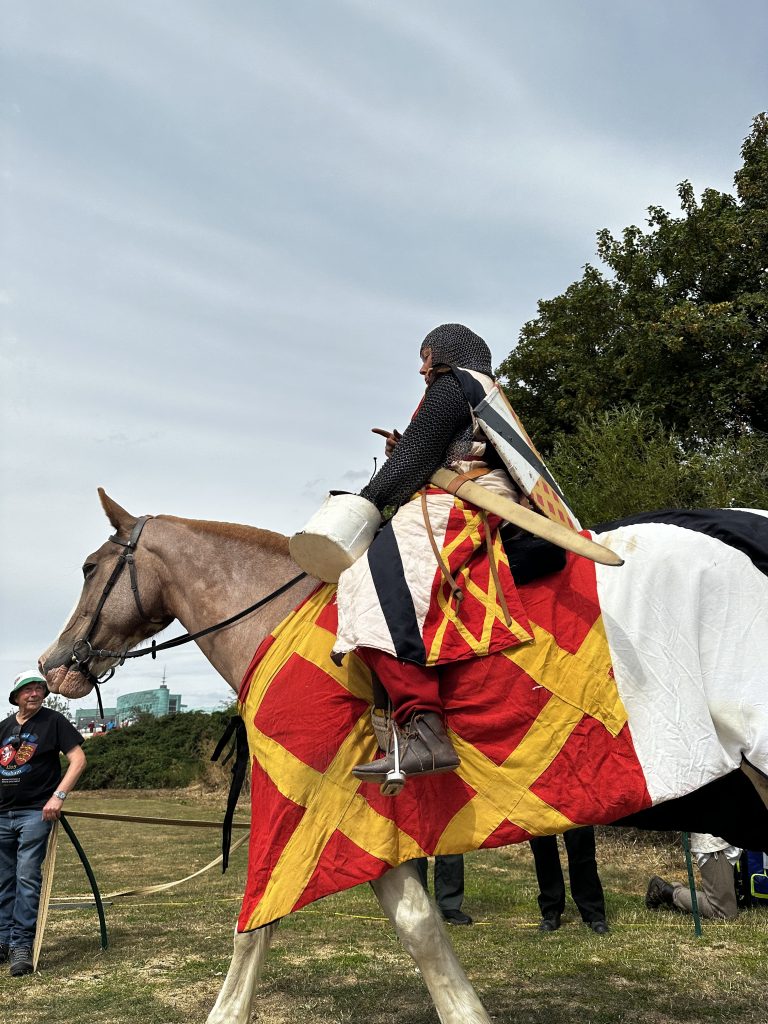
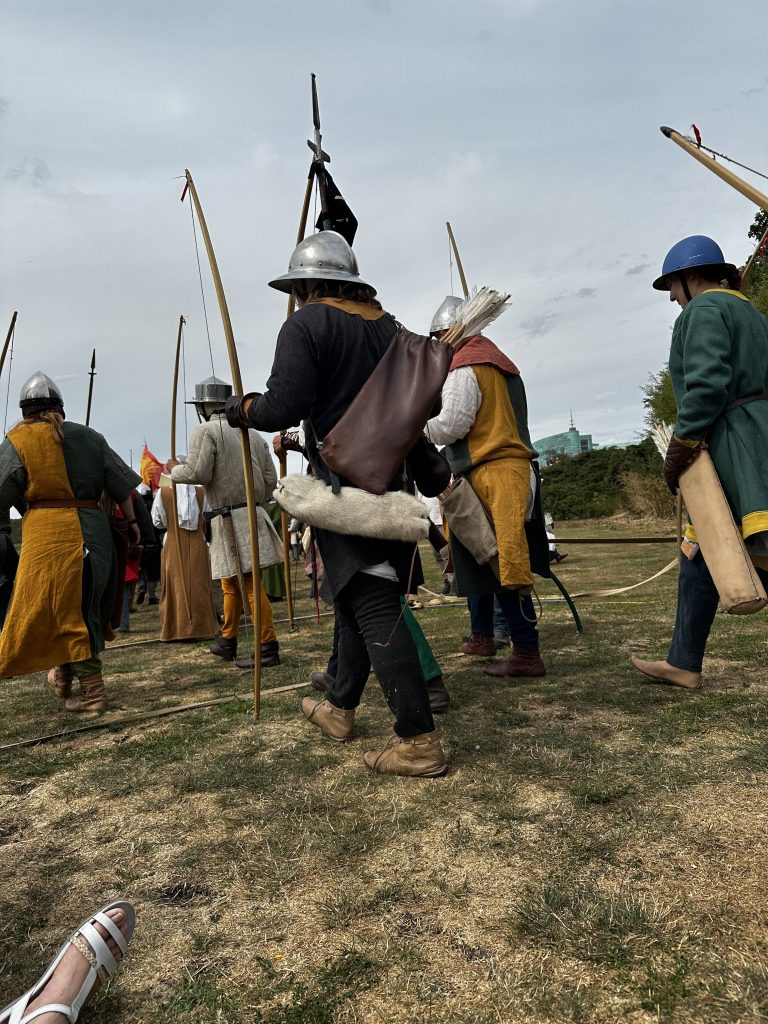
The spear was king among these. Cheap, versatile, and deadly in formation, it could stop a cavalry charge if held firm. The sword, by contrast, was a sidearm; a mark of status as much as a weapon.
Then there was the crossbow. Slow to load, but powerful enough to pierce armour at close range, it changed the balance of the battlefield. A well-placed bolt could bring down even a mounted knight, which is why crossbowmen were feared – and, sometimes, despised.
Tactics and the Shape of Battle
Commanders sought position above all else. High ground mattered, and so did terrain, such as rivers, woods and marshes. A wise leader would force his enemy to attack across difficult ground, breaking their formation before the lines even met.
One of the clearest examples is the Battle of Lewes in 1264. There, the forces of Simon de Montfort took the high ground and used it to devastating effect against King Henry III. The royal army, attacking uphill, lost cohesion. Once that happened, the outcome was almost inevitable.
Formations were crucial. Infantry might form dense lines or blocks with their shields overlapping. Cavalry, when used properly, struck at weak points – flanks, or gaps opened by missile fire.
But even the best plans could unravel. Dust, noise, and the sheer press of men made communication difficult. Once engaged, control slipped quickly from a commander’s hands.
Skirmishes and Ambush
Not all warfare took place in open battle. Small-scale fighting, such as skirmishes, raids and ambushes were often more decisive in the long run. A supply train cut off, a scouting party destroyed, a bridge held or burnt – these could shape an entire campaign.
Ambush, in particular, was a favoured tactic in broken or wooded terrain. The Welsh, for example, used it to great effect against English forces. At the Battle of Orewin Bridge, on 11th December 1282, Llywelyn ap Gruffudd was drawn into a vulnerable position and killed, a moment that effectively ended native Welsh resistance. War, therefore, was often decided not by strength alone, but by timing, deception, and knowledge of the land.
Sieges: The True Test of War
Battles could be swift and brutal – but sieges were slow and grinding.
The military landscape of the thirteenth century was defined by castles. Were they fortified residences, or residential fortresses? Either way, they exerted authority over a region. To take a castle was to take the land around it.
Sieges could last weeks, months, or even years. Attackers built engines: trebuchets and mangonels. These were used to batter walls or hurl stones over them. Soldiers dug mines beneath foundations, seeking to collapse entire sections. This was called “undermining”.
Defenders, meanwhile, relied on height, stone, and patience. Arrows and bolts rained down on attackers. Supplies were rationed carefully. Every day held was a small victory, but often it was starvation which decided the matter. A garrison might endure assault after assault, only to surrender when food ran out.
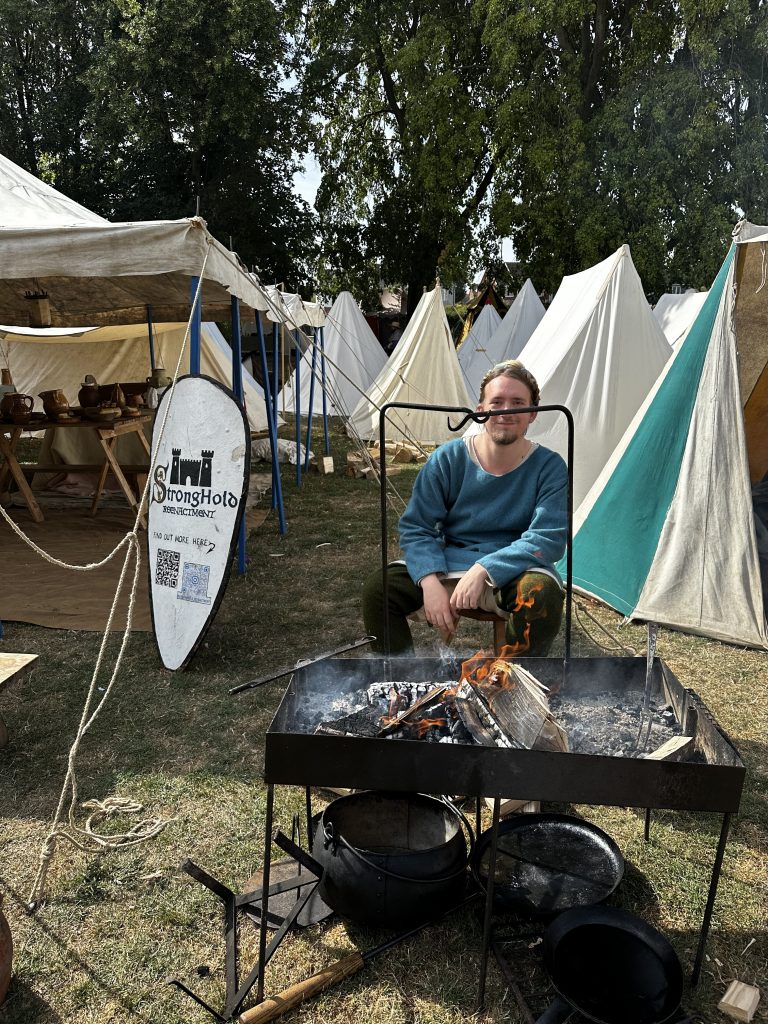
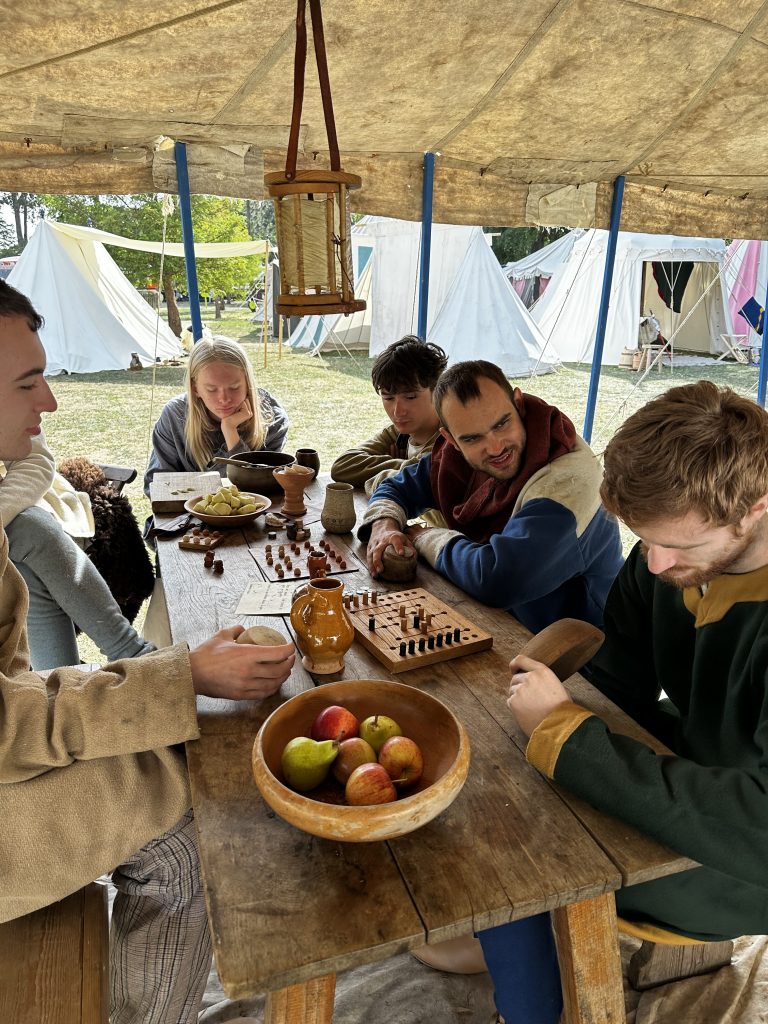
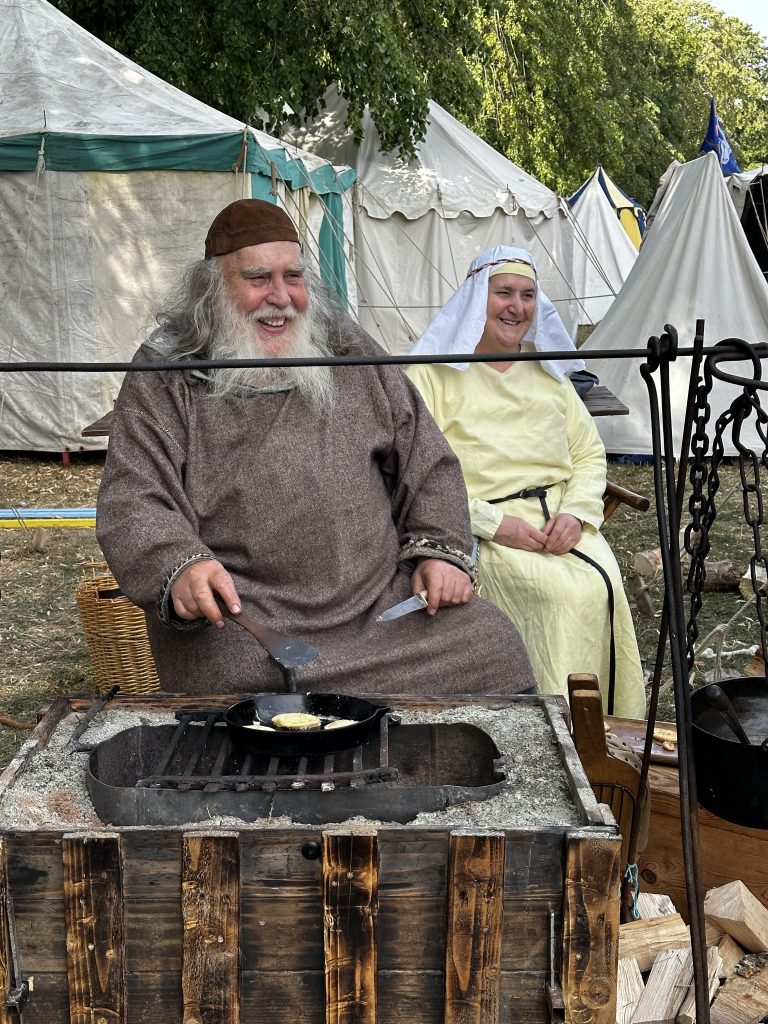
Re-enactors don’t just recreate battles. They often provide “living history” camps, with food cooked over open fires, canvas tents pegged out for sleeping quarters – a fascinating and authentic glimpse into the daily life of an army and its camp followers.
Defeat, Retreat and Survival
Victory was never guaranteed. Armies retreated as often as they advanced.
A retreat could be orderly, such as a planned withdrawal to stronger ground, or it could become a rout, where discipline collapsed and men fled for their lives. The difference lay in leadership and morale.
Defeat was rarely final unless a leader was captured or killed. More often, it was a setback – the campaign might be lost, but not the war. Men regrouped, lords negotiated and alliances shifted.
You could say that survival was often the true measure of success. To preserve your people, to withdraw intact, was sometimes wiser than to press a battle to its bloody conclusion.
The Human Element
It is easy to speak of tactics and arms, but war was, at its heart, a human experience.
Men marched for days with little food. They slept in the open, in rain and cold. They feared not just the enemy, but disease, injury, and the slow grind of exhaustion.
Then, when battle came, it was close and personal. There was no distance, no abstraction. You could see the face of your enemy. You could hear him breathe, shout and cry.
When we look back at thirteenth-century warfare, we should not romanticise it. There was courage, certainly; skill, too, and moments of honour. But there was also confusion, suffering, and loss.
Chronicles tell of victories and defeats, of kings and princes, tactics and outcomes. In my novels, though, I’ve tried to portray my battle scenes from the point of view of those who fought for their lives, their friends’ lives, their land or their honour.
In some ways, this is harder than merely giving the facts as we know them; but in other ways it’s easier, because the emotions experienced during a fight to the death are the same, no matter when that fight occurs. Just talk to any veteran.
I write historical fiction set within a carefully researched medieval framework, and I am open about where history ends and invention begins. Each volume in Tales of Castle Rory concludes with an Author’s Note, explaining which elements are historically attested, which are fictional extensions of the record, and which move deliberately into fantasy. The stories are rooted in real medieval experience – with the workings left visible.
-
The Comfort of Lost Lands
There is a particular comfort in the idea of a lost land. To call a place “lost” is to suggest accident rather than intent, misfortune rather than resistance. It softens the violence required to take it back. Across centuries, rulers have returned to this language again and again, finding in it a way to make war feel like restoration.
The idea of a “lost land” is the main subject of the first book in Tales of Castle Rory. In The Box of Death the tribe of Celts, banished to the swamps known as “Blurland”, want to reclaim their original homeland on the other side of a wide, fast-flowing river. The treaty has been lost, and the King of Mallrovia denies it ever existed. The Celts resort to aggression and invasion. Although they fail in this, their subsequent attempts at peaceful negotiation are successful. The “lost land” is reclaimed – for a while, anyway.
When Edward I marched into Wales in the late thirteenth century, he did not believe he was conquering a foreign country. Wales, in his mind, was a land that had slipped from proper control, and was now ruled by princes who had forgotten their obligations. Treaties had been broken, homage imperfectly rendered, borders insufficiently respected. What followed, therefore, was not invasion but correction. Order would be restored; law would be imposed; the world would be put back as it ought to be.
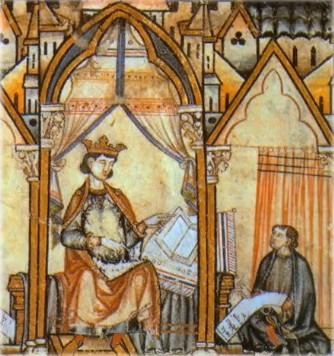
Book 5 of the Tales is called The Paradise Garden. One of the threads running through this book – and it’s laid before the reader right from the start, in the Prologue – is the taking over of all Spain by Alfonso X of Castile. Alfonso X was an inspired leader of men. He was a musician, a scholar, a seeker of knowledge and a man who made friends of Jews, Christians and Muslims alike. But he was also a conqueror. One of the last (although not the last) Iberian lands to hold out against him was Murcia, and it’s in Murcia that Book 5’s Prologue is set.
The Muslims of Murcia were killed, driven out or forced to convert to Christianity. Although it’s true that the Muslims themselves had conquered the area in the early 8th century, defeating the Christian Visigoths who lived there, by Alfonso’s time the Muslim population had been settled in Murcia for centuries. Tellingly, Alfonso called his campaign the Reconquista – the “Reconquest”. He was only taking back what was rightfully his. Restoring the country to Christianity. This is the eternal narrative of those who believe that their right to own and rule the land is more important than the lives of those currently living there. To Alfonso, Murcia was a “lost land”. To the Muslims who’d lived there for generations, it was their home.
King Alfonso X of Castile (“the Wise”), from the Cantigas de Santa María (c. 1250–1280). Contemporary manuscript illumination. Public domain.
Source: Cantigas de Santa María, Codex Rico (13th century), Royal Library of the Monastery of San Lorenzo de El Escorial (Patrimonio Nacional, Spain). Public domain.
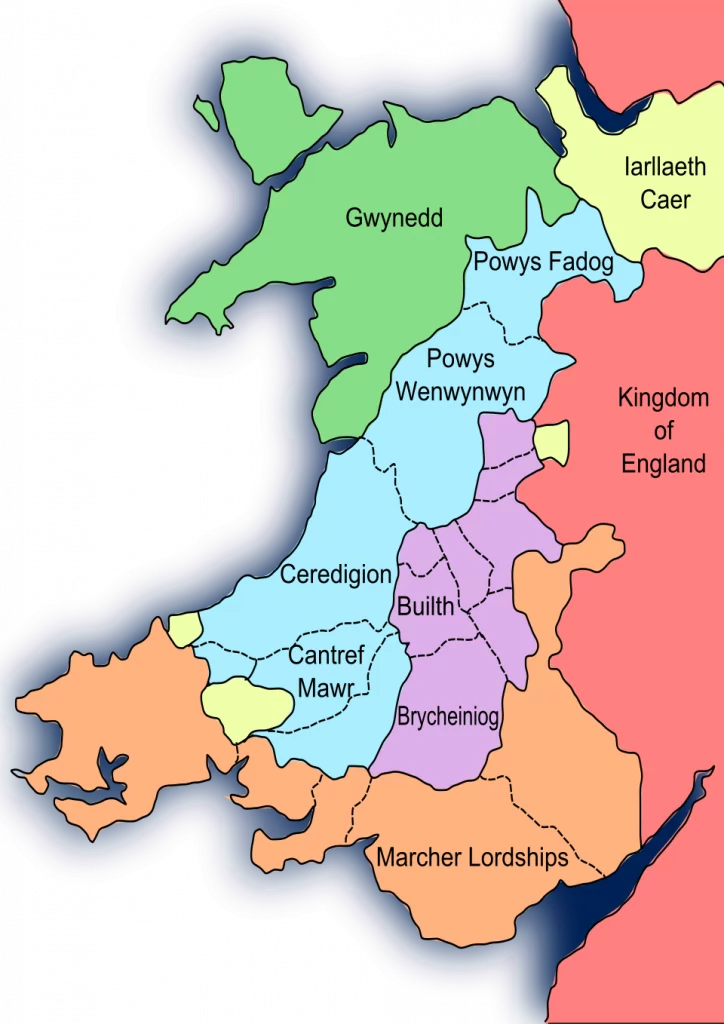
WALES AFTER THE TREATY OF MONTGOMERY, 1267
created by AlexD licensed under CC BY-SA 3.0 via Wikimedia CommonsIn Tales of Castle Rory, Book 9 is called The Whisper of Hiraeth. “Hiraeth” is a Welsh word. At its most basic, it means homesickness, but in reality it’s much more than that. “Hiraeth” directly invokes the idea of a “lost land” – lost, that is, to the person feeling the emotion. The Whisper of Hiraeth directly references the conquest of Wales by the English king.
Edward thought he was reclaiming his own lost land. Yet Wales was not lost. Its rulers traced their own lineages. Its laws shaped daily life, its language felt sacred. Edward’s certainty rested on a particular reading of the past, one that remembered only moments of English dominance, and ignored long stretches of Welsh independence. History was distorted, trimmed of its inconvenient parts.
Something similar echoes in the twenty-first century – in Vladimir Putin’s insistence that Ukraine is not truly separate from Russia. Here too the language is not of conquest but of return. Ukraine is framed as a wayward fragment, detached by error and manipulation, its independence a historical misunderstanding. It has to be corrected by force. The past is examined selectively: ancient Rus, imperial borders, Soviet inheritance. Whole centuries of Ukrainian self-definition are pushed aside as though they were footnotes rather than a people’s experience.
In both cases, the people who live on the land are treated as secondary to the story told about it. Their consent is unnecessary if the narrative is strong enough. If a ruler can persuade himself, and enough others, that a territory has always belonged elsewhere, then resistance becomes not self-defence but defiance. Violence becomes regrettable but necessary, a means to end disorder rather than create it.
There is danger in this way of thinking. It assumes that history has a single, correct direction, and that power decides. But to choose one moment and declare it definitive is to silence all the others.
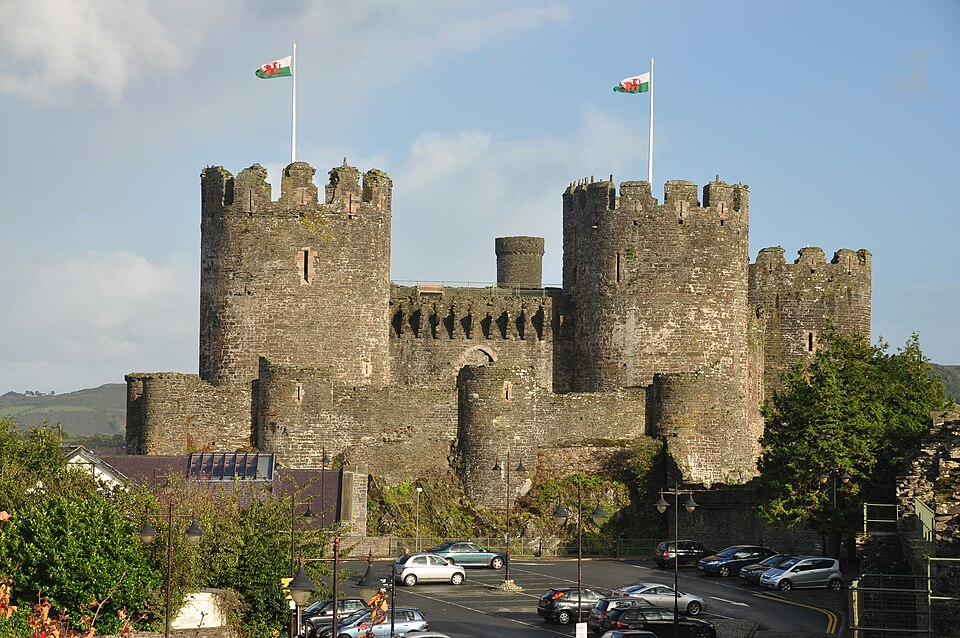
CONWY CASTLE
photograph by Nilfanion licensed under CC BY-SA 4.0 via Wikimedia Commons.Edward I ultimately succeeded. Wales was absorbed, its castles standing as stone arguments that “resistance is futile”. The story of loss was made real by force. Yet even then, the past refused to be silenced. Welsh identity survived conquest, law, and punishment, carrying its own memory beneath the imposed one.
Ukraine’s story is still unfolding. What is already clear, however, is that attempts to erase or diminish its nationhood have instead sharpened it. The insistence that Ukraine is merely a lost part of something greater has only underlined the cost of such thinking – in lives and in разрушенные города (ruined cities).
Perhaps this is the lesson: the idea of “lost lands” may comfort those who wield power, but it rarely reflects the truth. Countries are not mislaid objects waiting to be retrieved. They are lived in, argued over, and remembered differently by their inhabitants. When the past is used to justify violence, it is usually because the present does not consent.
And so the phrase “lost land” should always give us pause. It tells us less about the past than about the needs of those who invoke it. The Celts got their land back, but at great cost, and only after violence failed and subsequent diplomatic efforts prevailed. Edward I in Wales unleashed bitter hatred and an enduring defiance. The effects of Putin’s invasion of Ukraine are yet to be known, but are likely to be similar. The lessons of history are clearly yet to be learnt.
I write historical fiction set within a carefully researched medieval framework, and I am open about where history ends and invention begins. Each volume in Tales of Castle Rory concludes with an Author’s Note, explaining which elements are historically attested, which are fictional extensions of the record, and which move deliberately into fantasy. The stories are rooted in real medieval experience – with the workings left visible.
-
The Hours: How Time was Kept in the Castle
There is a tendency, when we think of medieval prayer, to imagine cloistered monks rising in the night, chanting in cold stone choirs, and returning to their cells in silence. And it is true: the great monastic houses ordered their entire existence around what were called the Hours – fixed moments of prayer that marked the passing of each day.
But the Hours were not confined to monasteries. They shaped the rhythm of life far beyond cloister walls. In a medieval castle, which was busy, political and often tense, the Hours would still have been present, though in a quieter, more flexible form. They were not always strictly observed, nor always complete. Yet they remained a constant thread, binding the spiritual to the practical, the eternal to the everyday.
To understand life in the castle, we must first understand what the Hours were.
The system itself owes much to early Christian tradition and was formalised in the West under figures such as Benedict of Nursia. The idea was simple: that time itself should be sanctified. Each part of the day – morning, noon, evening and night – was to be marked by prayer, so that no hour passed without reference to, and remembrance of, God.
In its full form, there were eight such Hours: Matins, Lauds, Prime, Terce, Sext, None, Vespers, and Compline.
In a monastery, these governed everything. In a medieval castle, they would have shaped life more gently, but no less meaningfully.
The day begins in darkness.
Long before sunrise, Matins would be said in religious houses. In a 13th century castle – for example, in Castle Rory in Hambrig – this Hour is unlikely to have been observed regularly. By the 1260s, Father Laurence is an old man. He’s devout enough, but he’s not surrounded by a community of monks. So the castle sleeps through the Hour of Matins. Guards pace the walls, but the chapel remains silent.
It is at dawn that prayer truly begins.
Lauds, the first light of day, is the most natural starting point in a place like Hambrig. The household stirs and fires are rekindled. In the chapel, Father Laurence offers prayers of praise as pale light enters through the east window. A few may attend: perhaps those already awake, perhaps those seeking quiet before the demands of the day. Others will be at their duties in the kitchen or the stables, or keeping watch on the wall-walk.
As the morning advances, the lesser Hours, Prime and Terce, pass almost unnoticed by most. These are short offices, easily said by a priest alone. Father Laurence may observe them faithfully, marking the Hours even if no one else does. For the rest of the castle, the day is in full motion: petitions brought before the lord, accounts tallied, riders arriving with news.
And yet, the influence of the Hours remains. There is an awareness that the day has shape and order. That noon is not merely midday, but Sext: a moment, however brief, when the world pauses.
At Sext, Father Laurence might return to the chapel. A servant or two might join him. Others might simply bow their heads where they stand. The association of this Hour with Christ upon the Cross lends it gravity.
None, in the mid-afternoon, carries a similar weight. By this time, the business of the day begins to wane. Fatigue sets in. Decisions made earlier may now be questioned. It is not difficult to see why this Hour, too, is linked to the Passion. In the castle, this is often the time when tensions surface – disputes among people, or worries that cannot be set aside.
Then comes evening.
Vespers is the great hinge of the day, and here, even in a secular household, we are likely to see a fuller gathering. The sun goes down. Work ceases. The castle begins to draw inward. In the chapel, candles are lit, their glow soft against the stone. Father Laurence leads the prayers. Voices, if there are enough, may join in response.
It is not merely a religious observance. It is a moment of collective stillness.
Finally, there is Compline.
This is the last prayer before sleep. It’s quiet and introspective, often penitential. The words are familiar, repeated night after night. “Lord, now lettest thou thy servant depart in peace…”
In Castle Rory, Compline would be a small and intimate gathering. Those who come do so not out of obligation, but inclination. The day is done. What has been said and done cannot be undone. Compline offers a moment to lay it all down, to seek forgiveness or simply rest.
After Compline, there is silence: not enforced, as in a monastery, but natural. The castle sleeps again.
What is striking about the Hours in this setting is that they don’t dominate life as they do in a cloister. Instead, they weave through the castle’s day with regularity and persistence. But, for this to happen, there needs to be a priest.
A priest like Father Laurence keeps the structure alive. He says the Hours whether others attend or not. In doing so, he anchors the spiritual life of the castle. Around him, others dip in and out. But whether they’re present or absent, they are aware of the rhythm he maintains.
In a world of uncertainty, of war, succession, loyalty and betrayal, the Hours offer continuity. They divide the day into something more than tasks and obligations. They remind those within the castle that time is not merely something to be spent, but something to be marked and offered to God.
I write historical fiction set within a carefully researched medieval framework, and I am open about where history ends and invention begins. Each volume in Tales of Castle Rory concludes with an Author’s Note, explaining which elements are historically attested, which are fictional extensions of the record, and which move deliberately into fantasy. The stories are rooted in real medieval experience – with the workings left visible. The practices described above are drawn from surviving legal and household records. Where Tales of Castle Rory departs from this evidence, particularly in its use of prophecy and symbolic objects, those choices are explained in the Author’s Notes at the end of each volume.
-
A Day in the Life of a 13th Century Nobleman
The lord of a border castle wakes at dawn, and begins his day with prayer. Kneeling before a simple crucifix, he recites the Lord’s Prayer in Latin, then reads from a psalter. By the time he rises, the household is stirring.
The heart of the castle is its great hall. Soon after dawn, servants begin sweeping the rushes. Trestle tables are set up by the kitchen team and benches dragged into place, all ready for the first meal of the day. The cook is already in the kitchen and the fire has been lit by one of the maids. In the hall, a dog noses underneath the trestle tables.
The lord breaks his fast with a simple meal of bread and ale. If there is cold meat left over from last night’s supper, he may eat a slice of that. His household joins him if they wish to eat in the hall, but this is not the main meal of the day, and people can enter and leave at will. At the high table on the raised dais, the lord meets his squires and knights, his chaplain and his steward The day is set up by these trusted people. Then the work can begin.
A medieval lord is not merely a landowner; he is administrator, judge, military captain, landlord, diplomat – and beholden to the monarch. In the case of my fictional Lord of Hambrig, who is tenant-in-chief to the monarch, this last responsibility supersedes all the others. However, the lord’s post as tenant-in-chief does not impinge often on his day-to-day duties.
The 13th century is not a static world. It is restless – legally, politically and economically – moving forward as times change, although sometimes reluctantly. Written records are becoming increasingly important, so charters must be sealed, fines must be noted down, and boundaries described in clauses which run for lines and lines of crabbed script, and must leave no room for misinterpretion or dispute.
Therefore, the steward must present figures: rents collected, arrears outstanding, grain tallies from the demesne fields. These are the fields which the lord actually owns, and which provide food for his family and household.
The steward will also inform the lord of anything requiring action or judgement. Perhaps a millstone needs repair, or a tenant has died without a known heir. The lord must decide who inherits. He must organise (and pay for) the repairs. These things are not trivial; the lord knows that grain not milled in August will mean hunger in the winter.
Later in the morning, there will be a manorial court. The lord will sit in judgement, hearing disputes between tenants, allegations of theft, arguments over land rights and so on. He sits in a chair on the raised dais, oaths are sworn and witnesses speak. Authority must be seen and heard; punishments must be just and proportionate; victims must be compensated.
The main meal is dinner, eaten roughly at 1 o’clock, perhaps pottage with meat, barley and herbs. Fish will be served on fast days. People talk, and the lord listens. Information is survival – in a frontier shire especially.
After dinner, the lord may ride out to inspect boundary markers and perhaps visit the mill. He may go to the river crossing which brings income in the form of tolls, but which must be defended and guarded at all times. Sometimes he will train with his garrison – shield work, archery practice, or mounted manoeuvres. It is important to be prepared. To be ready.
By late afternoon, the administrative work returns, with letter writing (or dictation to a scribe) and the wrapping up of any outstanding matters. Letters are sealed by pressing embossed metal into warm wax. Identity in this age is both visual and hereditary.
As evening approaches, the hall is readied for supper, a lighter meal than dinner. The fire is lit and there may be music by the hearth, or a bard to tell stories. Often, supper is left-overs from dinner, with added bread and perhaps a lentil stew. Bowls and platters of food are arranged on trestle tables positioned end-to-end down the centre of the great hall, and – as with breakfast – people can enter and leave at will. Some choose to take their food back to their barns or workshops.
In his chamber that evening, lit by candlelight or rushlight, the lord may read for an hour or so. His reading matter will depend on his mood and his upbringing. Perhaps something classical, or it might be the Psalms. Even a romance – yes, these were very popular!
Eventually, the lord puts away his books, extinguishes his candles and lies down to sleep. But perhaps, first, he thinks. After all, the castle never sleeps. A lantern glows in the gatehouse, and a watchman patrols high up on the wall-walk. The lord is powerful within his estate, yet constrained by forces above and beyond him. He has power over his tenants, but he must bow to the king. He can strengthen the defence of his walls, but he cannot control the weather which ruins his crops.
This is the important thing to remember: the 13th century lord is not a figure of perpetual action. He is a man of sustained responsibility. His life is a constant round of decisions. Day after day of balancing justice with mercy; caution with courage; thrift with generosity. The responsibility weighs heavily.
Behind the stone walls and the heraldic shields stands, not merely a warrior, but a man who must hold together land, household and reputation with imperfect information and finite strength.
At dawn tomorrow, he will wake again before the hall stirs.
And he will begin it all over again.
I write historical fiction set within a carefully researched medieval framework, and I am open about where history ends and invention begins. Each volume in Tales of Castle Rory concludes with an Author’s Note, explaining which elements are historically attested, which are fictional extensions of the record, and which move deliberately into fantasy. The stories are rooted in real medieval experience – with the workings left visible. The practices described above are drawn from surviving legal and household records. Where Tales of Castle Rory departs from this evidence, particularly in its use of prophecy and symbolic objects, those choices are explained in the Author’s Notes at the end of each volume.
